Bats
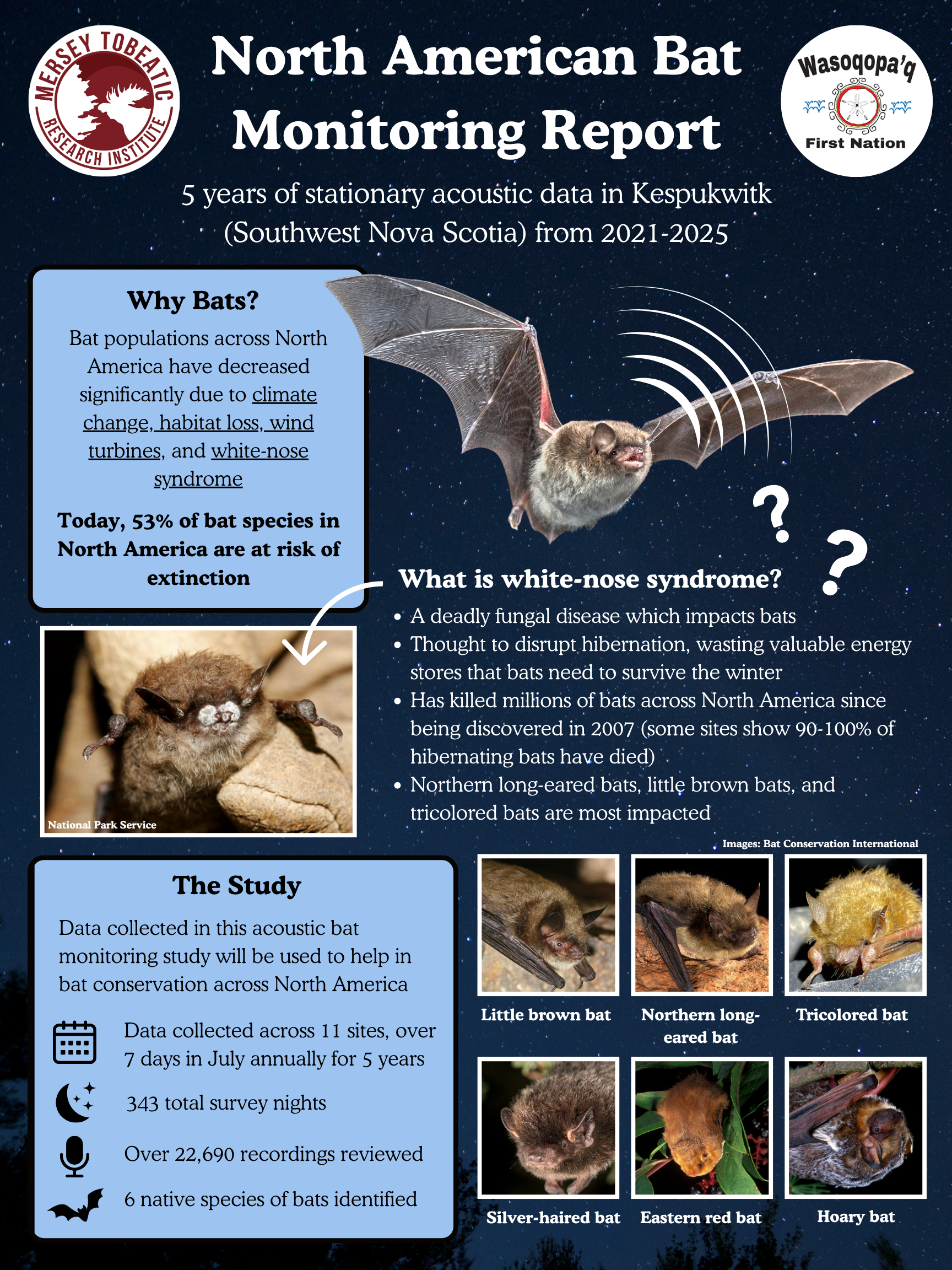
Bats used to fill the skies in Nova Scotia, but over the winters of 2011-2013 their populations dropped by 95%. This was due to the newly introduced fungal disease white-nose syndrome that affects bats as they hibernate.
Bats are crucial mammals in our native ecosystems and consume massive amounts of insects each night. Since their decline, MTRI has been monitoring, researching and teaching Nova Scotians all about the wonders of bats. We also collect and manage public sightings of bats in Nova Scotia and use this information to identify maternity colonies and work with private landowners and provincial partners to monitor these sites.
Nova Scotia is home to six bat species. Three of these species are hibernating, or “resident” bats. The other three species are migratory bats. All our bat species are insectivores, meaning that they eat insects which helps keep mosquito and pest levels down! There is an additional 7th species that has been documented in Nova Scotia, the Big Brown Bat, but there are few occurrences to date to we continue to monitor for more records of this species. Read more about NS species through our NS Species at Risk Guide or our Atlantic Canada Species at Risk Guide.
Want to learn more? Read below and check out our report on 10+ years of collecting and manage NS bat sightings in English or French
Did you see a bat? Business card style English & French or magnet style English & French
Questions? Email or call us! See report a sighting information.
Resident Bats
Little Brown Myotis bats are the most common bat in Nova Scotia, though their numbers are still very low due to white-nose syndrome. They are 4-11 grams with a 22-27 cm wingspan. They have brown fur that is darker near the base, with fur under their chin and on their belly that is a lighter brown/grey. Their wings and face are brown, and they have small, black ears, and a round tragus (prominence in front of the ear). They are endangered in Nova Scotia.
The Little Brown Myotis bats roost during the day in small, enclosed spaces. These include natural features like hollow tree cavities and rock crevices as well as human built structures such as buildings, like barns and attics and bat boxes. They prefer habitats near water, forest edges, and fields where there are lots of flying insects.
Females will roost in maternity colonies for most of the summer, where they will give birth to and raise one pup each. These pups will begin to fly after about three weeks. Males are mostly solitary throughout the summer. All Little Brown Bats hibernate together with other bat species in caves or abandoned mines.

Photo by Jason Headley
Northern Myotis bats (formerly known as the Northern Long-eared Bats) are 4-7 grams with a 23-26cm wingspan. They have brown fur with a lighter brown/grey fur under their chin and on their belly. Their wings are brown and their face is brown with a pink tint. They have large, black ears and a long, pointy tragus (prominence in front of the ear). They are endangered in Nova Scotia.
The Northern Myotis bats roost during the day in mature forests. Females will roost in maternity colonies for most of the summer, where they will give birth to and raise one pup each. These colonies are found in large trees with cavities and cracks. Males roost alone in trees. These bats hunt in forest gaps and edges. All Northern Myotis bats hibernate together with other bat species in caves or abandoned mines.

Photo by Jordi Segers
Tri-colored Bats (formerly known as the Eastern Pipistrelle) are the least common resident bat in Nova Scotia. They are 5-7 grams with a 22-25cm wingspan. They have fur with three bands of colour, hence their name. The base of their fur is black, the middle is blonde, and the tip is brown. Their wings are brown and their face is reddish-brown with a distinct snout. They are endangered in Nova Scotia.
The Tri-colored Bats roost in large clumps of Old Man’s Beard lichen (Usnea species), which has not been observed outside of Nova Scotia. Females will roost in small maternity colonies of around 12 bats for most of the summer, where they will give birth to and raise two pups each. Within Atlantic Canada, southwest Nova Scotia is the only area known to date with known maternity roosts. Males roost alone. These bats hunt for aquatic insects over water in forested areas. All Tri-colored Bats hibernate together with other bat species in caves or abandoned mines.

Photo by Hugh Broders
Migratory bats
Hoary Bats are the largest bat in Nova Scotia. They are 20-35 grams with a 34-41 cm wingspan. They have thick fur with a brown base and greyish-white tips, giving them a “hoary” colouring. They have yellow fur around their brown face, with round ears that have a black border. They are endangered in Canada (COSEWIC).
Both sexes roost solitarily in mature trees near forest edges where females will give birth to and raise two pups. Canadian Hoary Bats migrate south for the winter, and will do so in groups. These bats make up a large percentage of bat fatalities from wind turbines in North America.

Photo by Jordi Segers
Eastern Red Bats are 8-18 grams with a 28-33 cm wingspan. They have bright orange to red fur with a white patch below their jaw. They have a short, broad snout and pale, rounded ears. They are endangered in Canada (COSEWIC).
Both sexes roost solitarily in tree foliage and camouflage as dead leaves or pinecones. They hunt around forest edges, clearings, and streetlights. Females give birth to an average of three pups, but up to five. The Eastern Red Bat migrates south for the winter.

Photo by Nicole (No last name)
Silver-Haired Bats are 9-13 grams with a 20-35 cm wingspan. They have black or dark brown fur with silver tips, and small, round ears with pink on the inner rim. They are endangered in Canada (COSEWIC).
They roost in hollow trees and crevices, largely in old-growth forests. They will roost solitarily or in small groups, with females roosting in small maternity colonies and giving birth to one to two pups each. They hunt near forest edges and ponds. Silver-Haired Bats migrate south for the winter.

Photo by Jordi Segers
Sources:
Bat Conservation International
Photo Field Guide to the Bats of Ontario
Frequently Asked Questions
Where do I report bat sightings?
Bat sightings can be reported to the NS Bat Conservation Network at batconservation.ca. If you are unable to do so using the website, contact us at bats@merseytobeatic.ca or 1-866-727-3447. Please know due to the volume of bat reports we receive, we are unable to respond to all sightings individually. We thank you for your time and contributions toward bat conservation. Bat sightings and questions can also be directed to the Atlantic Canada Bat Hotline, see here for details. You can learn more about bat sightings collected to date in this report (English or French). For business cards or magnets and stickers on how to report NS bat sightings, click on the linked text. We also have a bat sighting report datasheet you can print and send us English French
What is White-nose syndrome?
White-nose syndrome is a disease that affects bats while they’re hibernating. It’s caused by an introduced fungus called Pseudogymnoascus destructans, or Pd for short. Pd grows on bats’ wings and faces, giving them a “white nose”. While hibernating, bats remain relatively inactive, lowering their body temperature and heart rate. When infected with Pd, bats wake up and become more active, which quickly burns the energy stores they need to survive the winter. This leads to starvation, dehydration, and death. Check out https://www.whitenosesyndrome.org/ for the latest map of the disease and more information.
How do I build and install a bat box?
We recommend following the most up-to-date guidelines for Canadian bats that is informed by a three-year long study (2021-2023) that looked at bat boxes used and unused by bats. MTRI helped contribute to this study by working with Nova Scotians to learn more about the best design and placement for local bats. The guidelines to build, install, and monitor a bat box can be found here. Additional resources can be found at helpthebats.ca
For additional resources, please check out the following: For Atlantic Canada, check out this brochure and poster. Canada and the USA guidance https://www.albertabats.ca/bathouses/
To count bats, please new our guide on conducting a bat count English French and datasheet English French
What do I do if I find a dead bat?
Make a report to batconservation.ca with any photos you have of the bat and if you have any suspicion as to how it died, such as via a pet cat or hit by a vehicle. Freeze it in a zip-locked baggie (double-bagged) without making direct contact with it. From there, we can collect it for testing. If you suspect there was any direct contact made with the bat by you or a pet, contact the Canadian Wildlife Health Cooperative's Atlantic Bat Hotline at 1-833-434-2287 (BATS) or atlanticbats@cwhc-rcsf.ca. They will be able to provide you with the proper information to ensure your and your pet’s safety. If the bat is alive, tips for removing a bat safely can be found here.
What do I do if I touched a bat?
Contact the Canadian Wildlife Health Cooperative's Atlantic Bat Hotline at 1-833-434-2287 (BATS) or atlanticbats@cwhc-rcsf.ca immediately. They will be able to provide you with the proper information to ensure everyone’s safety including pets and if direct contact is unknown i.e., a bat found in a room where someone was sleeping.
What are good resources for more information on bats?
We recommend seeking information from bat experts such as the Canadian Wildlife Health Cooperative, Canadian Wildlife Federation, Bat Conservation International, Merlin Tuttle and beyond. We also enjoy learning more about bats through podcasts, books, audiobooks and online webinars. The NS Young Naturalists Club by Nature NS has a family bat guide found under mammals here. MTRI is also working on producing more resources on you can support bat conservation, see below for more information.
How can I support bat conservation?
There are lots of ways to help support bats in Nova Scotia! One is to plant a bat-friendly garden. These consist of pale, native wildflowers attractive to moths (a bat's favourite meal). Some plants to consider include mountain fly-honey suckle, goldenrod and primrose. Also reducing the amount of light around your house and garden at night helps. More information about bat-friendly gardens, as well as other ways to help, can be found here: https://www.batcon.org/about-bats/bat-gardens-houses/
Leaving old trees, barns and/or sheds standing, as long as they don't pose a safety hazard, can be a great way to ensure there's habitat for the bats. Installing a bat box can also help provide this habitat. See “How do I build and install a bat box?” in our FAQs for bat box resources.
Reducing the use of pesticides, keeping cats indoors, and supporting the conservation of forests and wetlands are also great ways to help protect bats.
If you have other questions or concerns, please reach out to us by email at bats@merseytobeatic.ca (preferred) or at 1-866-727-3447.
We have newly developed resources to empower Nova Scotian's to support bat conservation. Click on the images below for PDFs of the content and a link after to the French version.
Bat Friendly Garden Brochure


Bat Friendly Garden Brochure French Version pdf
Five Principles for Bat-Friendly Forestry


Five Principles for Bat-Friendly Forestry French version pdf
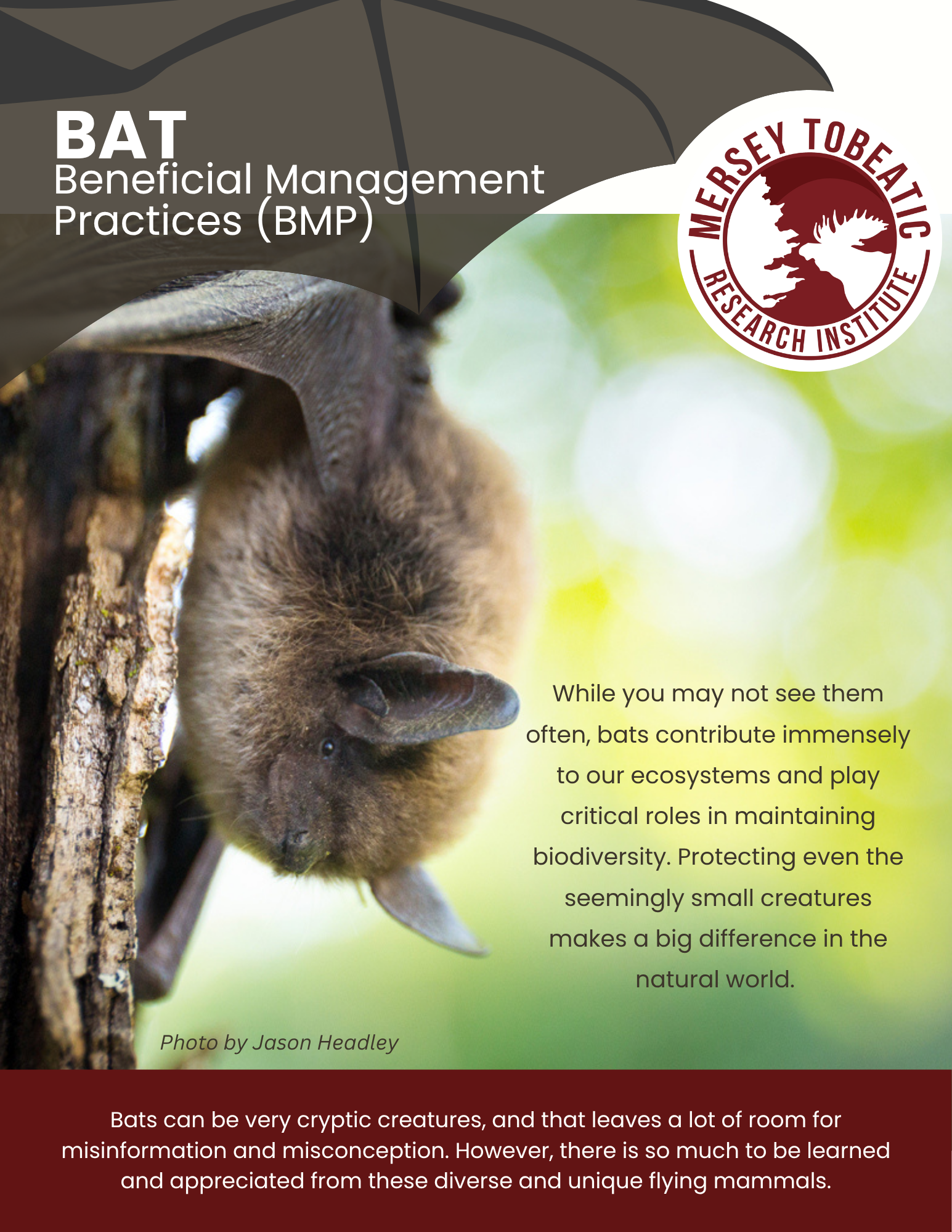
Beneficial Management Practices for Bats (short version)


Beneficial Management Practices for Bats (short version) French pdf
Beneficial Management Practices for Bats (detailed version)
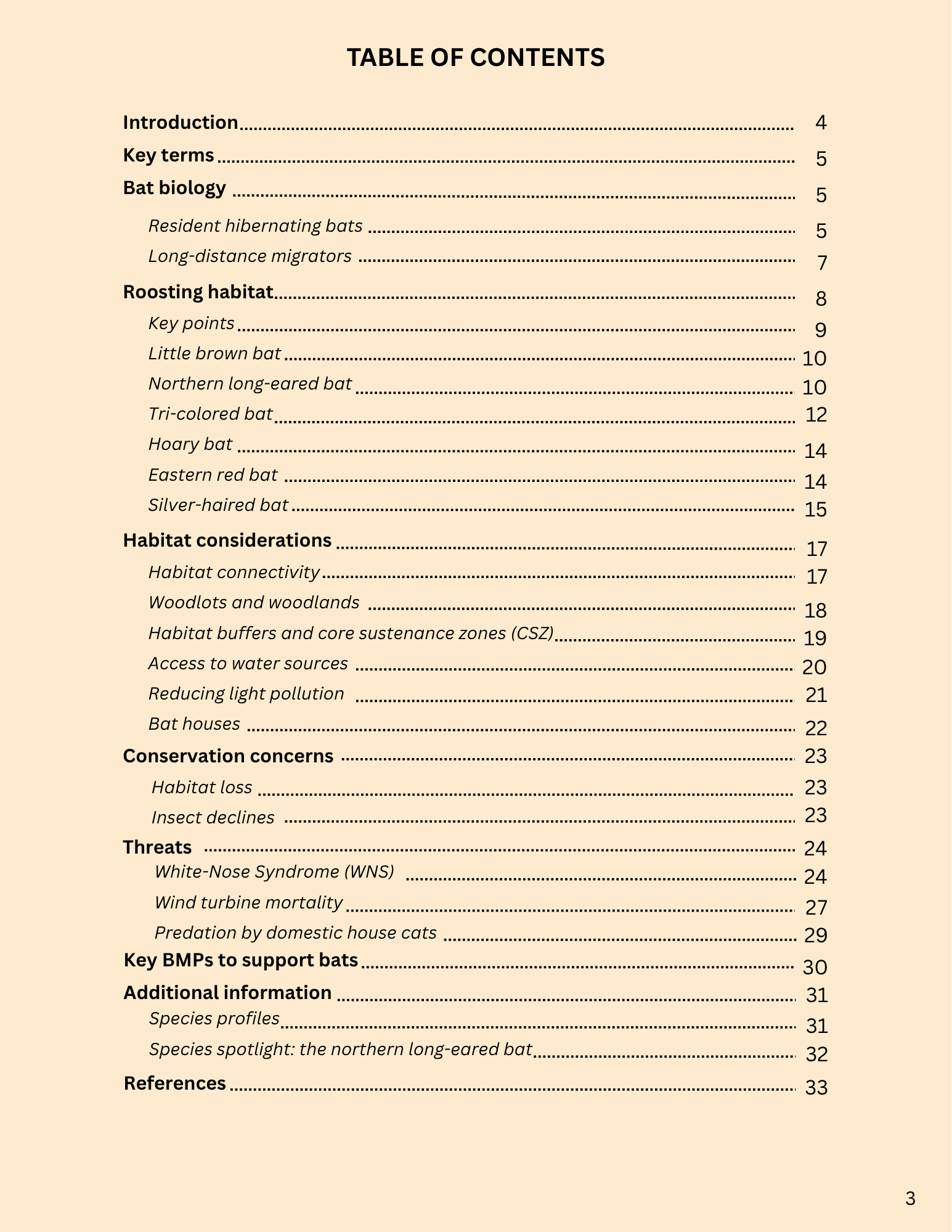
Beneficial Management Practices for Bats (detailed version) French
NS Bat Report Sticker
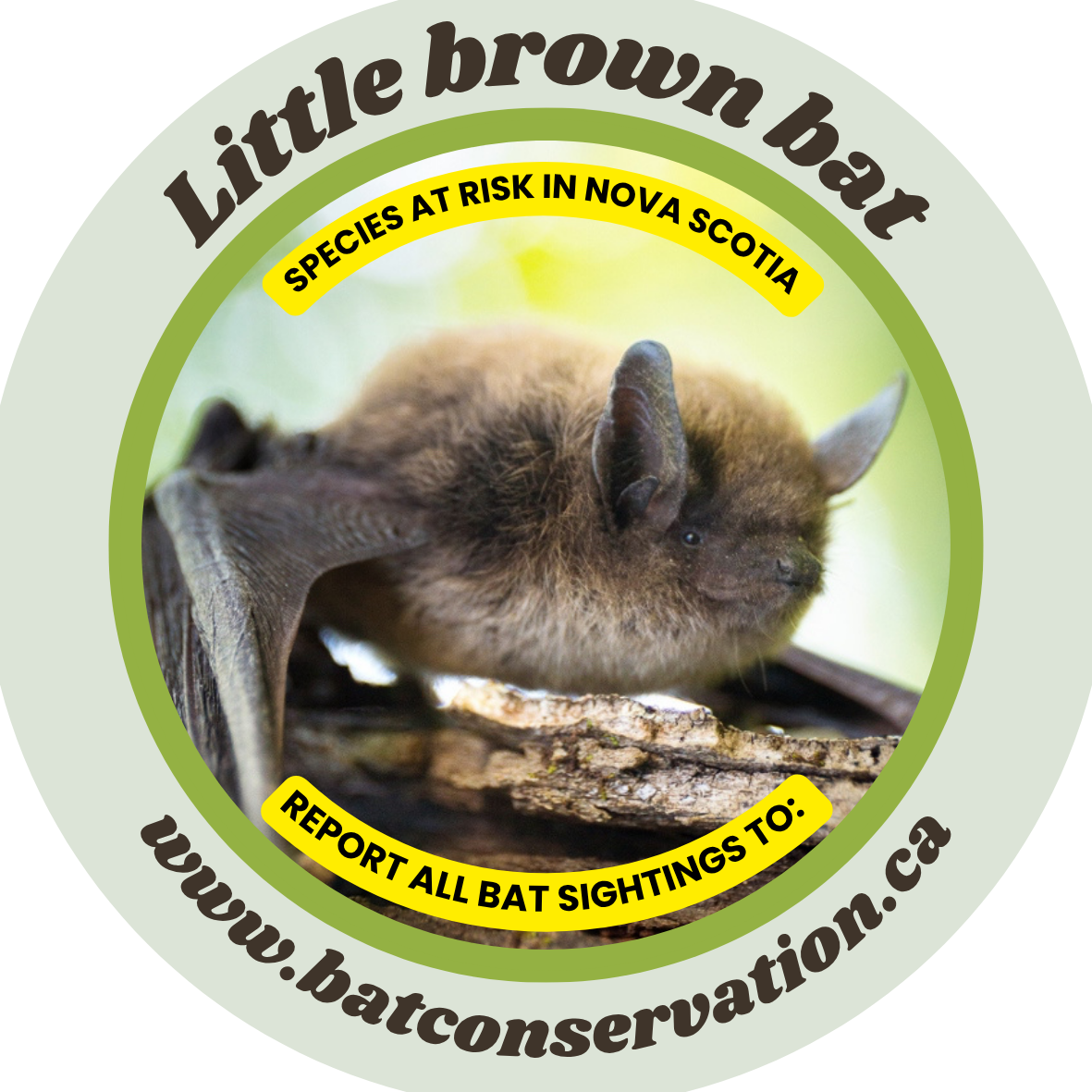
French NS bat report sticker or both languages and special thanks to Jason Headley for the photo and Bijoux Wilcox for designing the sticker.
Highlighted Reports
Click report images for full report: