
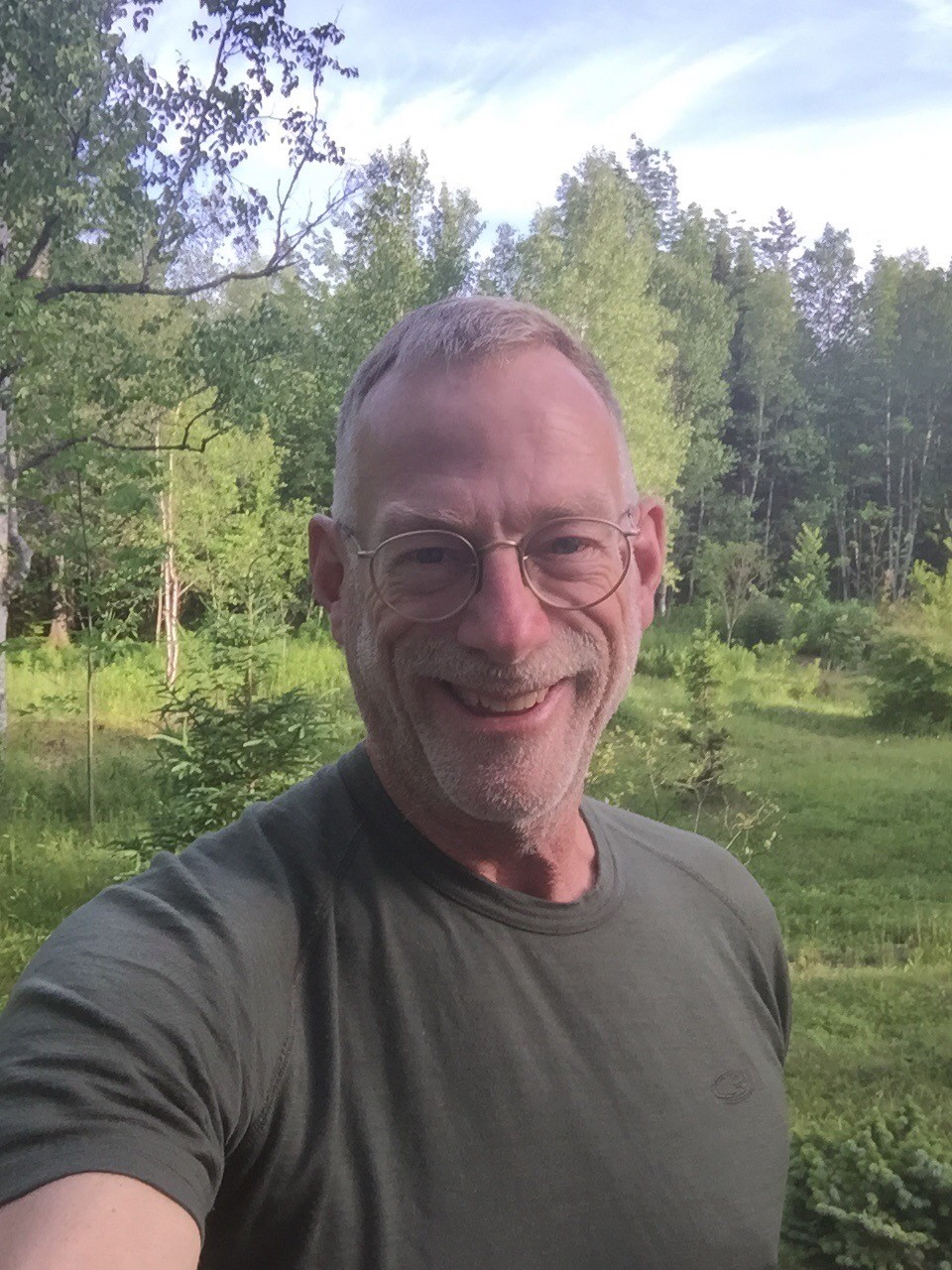
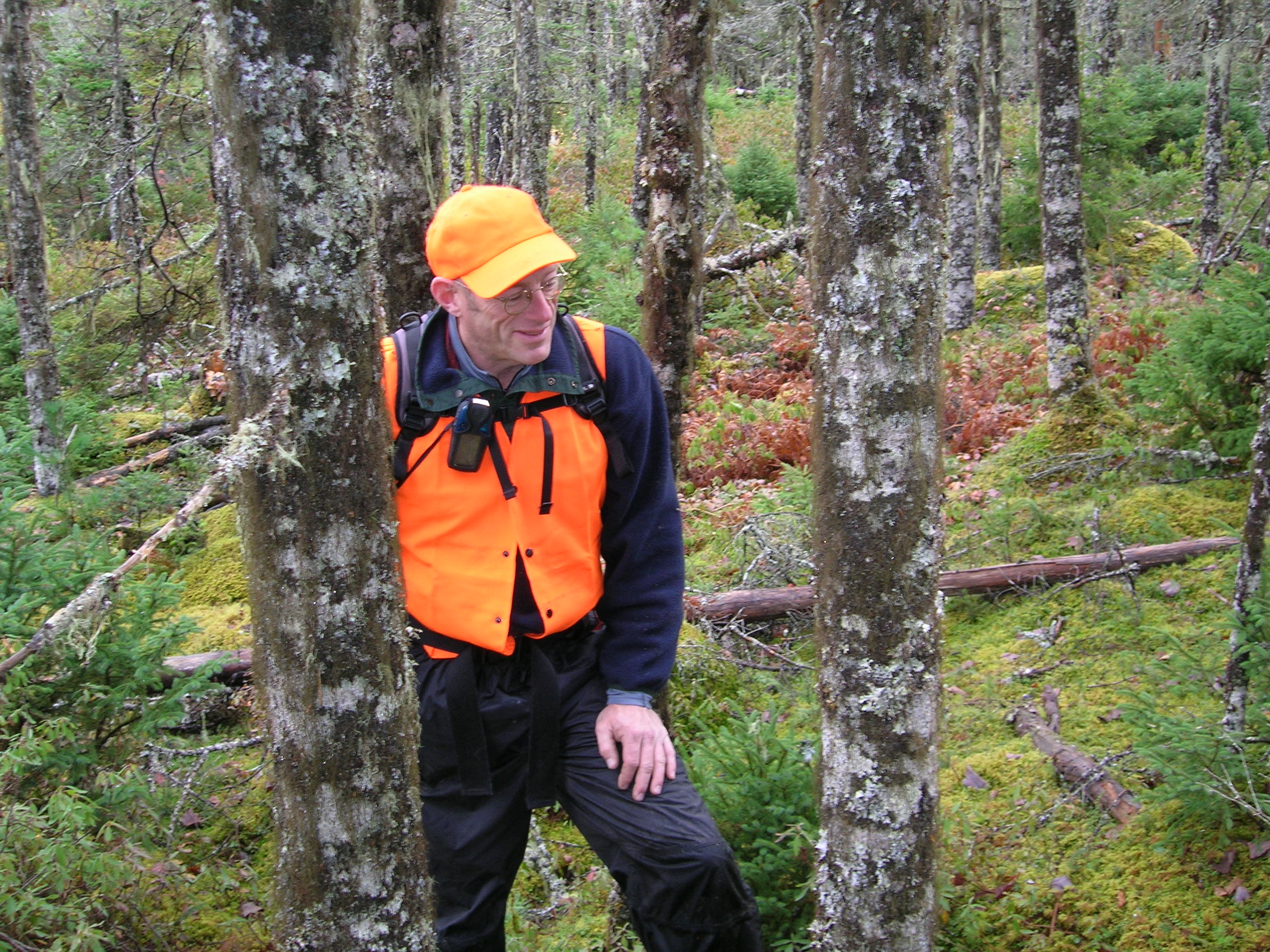
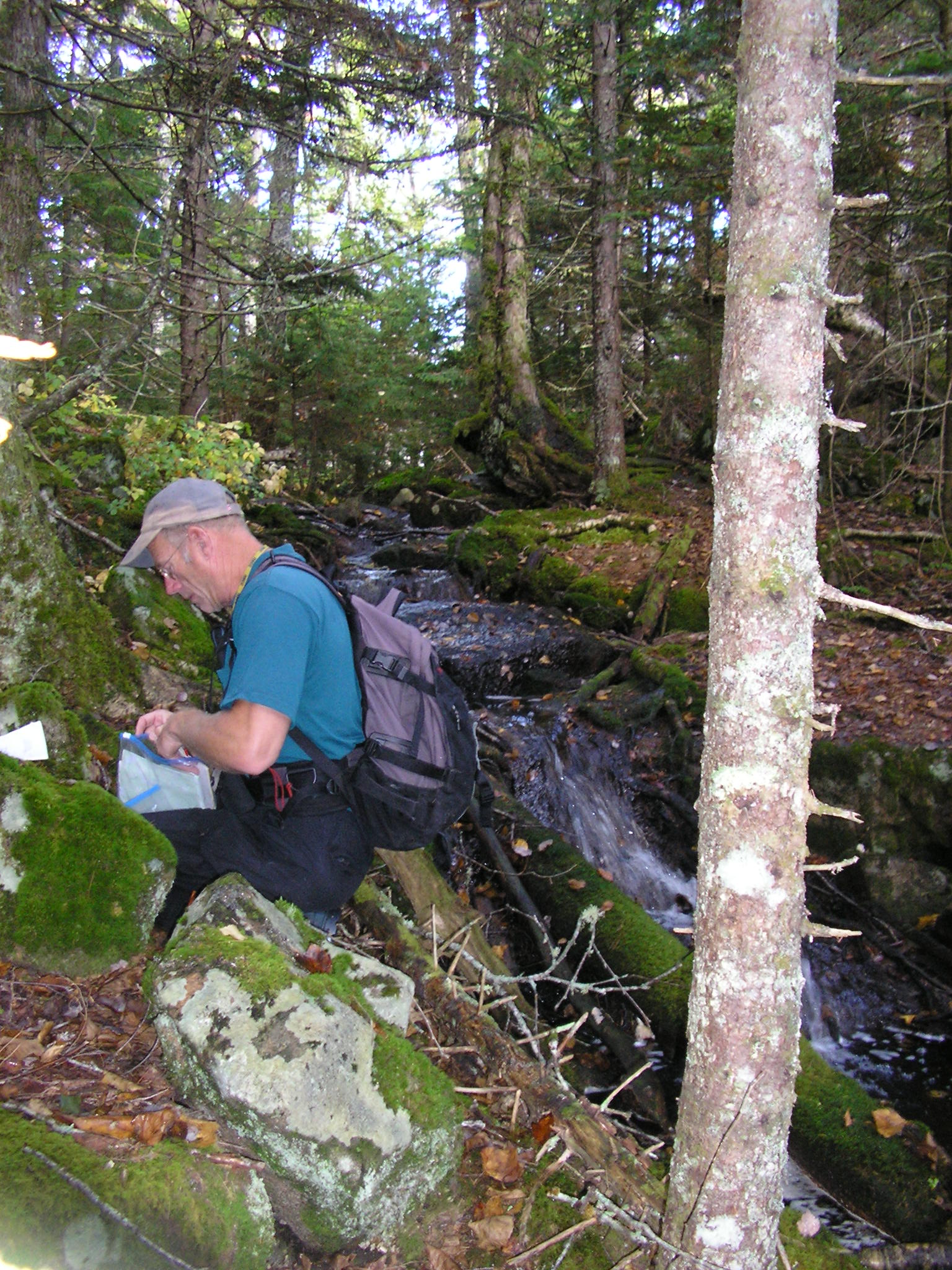
It was with great sadness that MTRI learned of the passing of Tom Neily. Tom was a long-time employee of MTRI and friend to many current and former staff, board members and volunteers. Tom started working with MTRI in the very early days of the organization (2007/2008) as a part of monitoring the few known Boreal Felt Lichen sites. Throughout his time at MTRI Tom discovered over 400 new Boreal Felt Lichen host trees. His tireless work over the course of a decade and a half greatly increased what we know and understand about Boreal Felt Lichen and other rare cyanolichens and their habitats in Nova Scotia.
This page brings together memories from people who knew, worked with, and learned from Tom. We are grateful to Frances Anderson for pulling these reflections together and to everyone who shared their memories.
Brad Toms, MTRI
Tom contributed or co-contributed over 5600 species records in the ACCDC database and had 3597 records on iNaturalist encompassing hundreds of species of moss and lichen. Tom documented many species of lichen and moss in Nova Scotia that were new to the province and new to Canada. Over the course of his career with MTRI, from his GPS tracks, we know that he travelled over 8000km on foot through the woods on lichen searches! Mosses (and especially sphagnum mosses) were a special interest for Tom. He contributed to moss and lichen courses hosted in NS, took courses at Eagle Hill in Maine and he contributed thousands of meticulously identified and curated mosses and lichen specimens to herbaria that will be a critical record for future bryologists and lichenologists to reference. He spent countless hours at his microscopes, identifying species, following keys and emailing experts when he got stumped or found something that didn’t fit the keys. Many of his earliest lichen records are already being used for long term monitoring sites to track the persistence of sensitive lichen species over time.
Tom was (almost) always willing to take people out into the woods and show them rare lichens. Many people in industry, government, ENGOs and academia benefited from his mentoring and guidance. As the 'go to' person for Boreal Felt Lichen, time in the woods with Tom was the only way for aspiring lichenologists to truly get familiar with Boreal Felt Lichen habitat. He was very generous with his time. Tom had a wicked sense of humour (that sometimes was hard to detect), a warm smile and truly enjoyed his time in the woods. Tom was always incredibly humble and always downplayed the importance of his work and his own expansive skills and experience. Tom was a valued member of the provincial lichen recovery team for many years and contributed to establishing many conservation efforts that are in place today to keep our rarest lichens from extirpation and extinction. He discovered many previously unknown old growth and climax forest sites, some of which became future nature reserves and wilderness areas.
In a perfect world somebody with Toms skill sets would have been given free rein to roam the woods documenting and collecting lichens and mosses wherever his heart led him, but even in the limited time he had with MTRI each year, outside of consulting work to pay the bills, he produced impressive, meaningful and long lasting collections and data that we should all strive for.
Chris Pepper, Field Biologist and Consultant
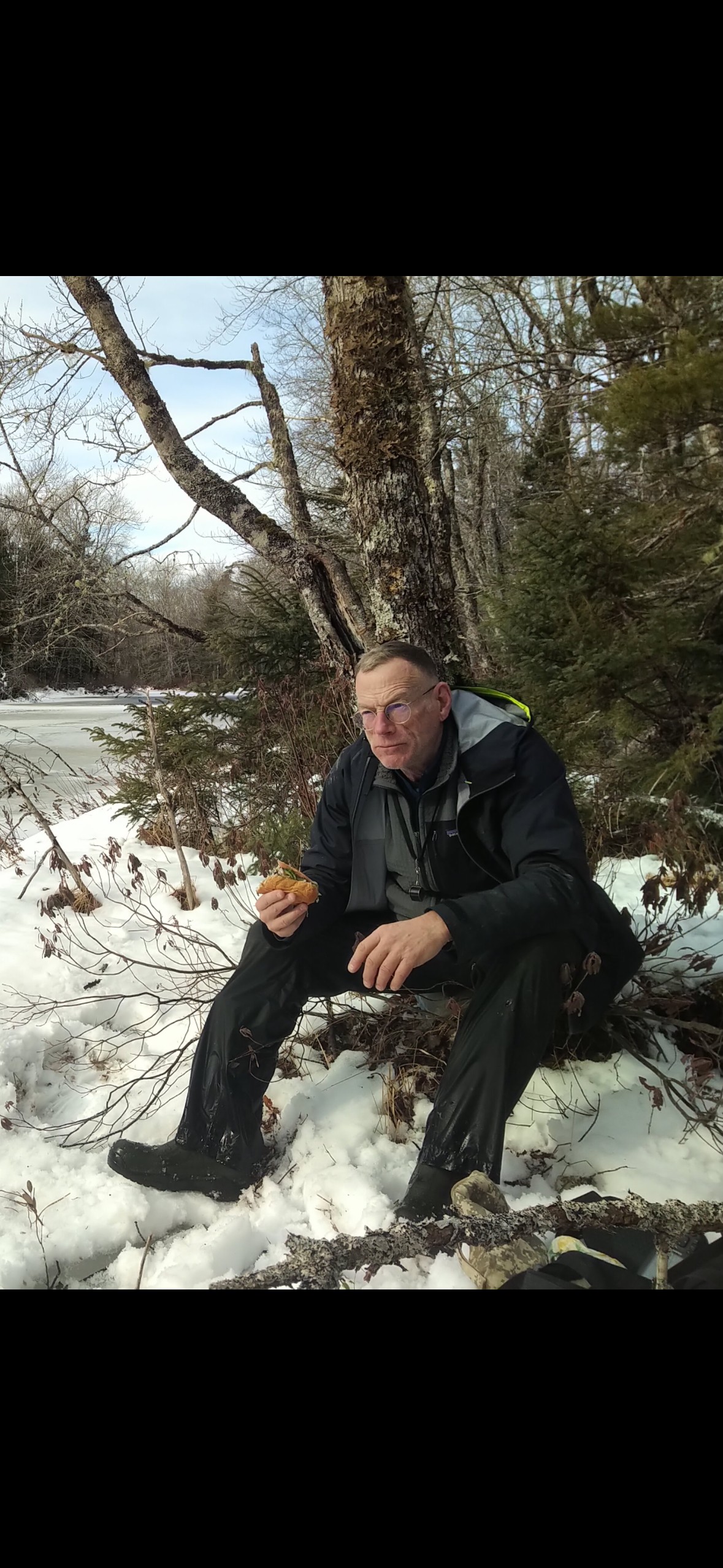
I did work a lot with Tom, right up until his first cancer operation actually. Besides being a fantastic botanist and mentor, I was always amazed how well he knew his way around the province, and how many people remembered him. I always got a kick out of random people in random towns approaching him and asking, "are you still looking for that moss Tom?".
One of my favourite things about spending a lot of time with Tom was hearing him tell stories from his past. He went from being a rural farm boy, to a partying cheesecake business owner in Montreal, to living off grid as a lichen/moss/plant biologist. Hard to picture him smoking cigarettes and partying in downtown Montreal...
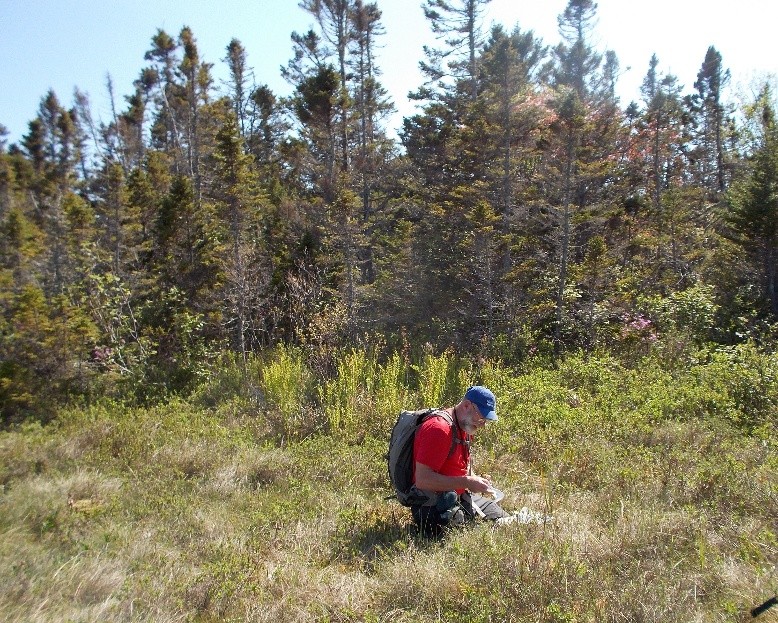
He didn't like getting his picture taken and I don't take pictures of people very often so most of my pics would probably be of BFL trees with him in the background. In fact, I specifically remember him asking if he was in this picture with a partially sarcastic concerned tone. This was from January, 2020, I believe it was on Broad River.
Marian Munro, former Curator of Botany, Nova Scotia Museum
I met Tom and his then partner back in the 90s. They were living off grid in Centre Burlington area and neighbours to friends of mine. He was a baker at the time. Throughout that summer I learned of his botanical background, quite by accident as Tom was ever so humble, and talked him into working a contract in the herbarium. He followed up with volunteer work. When I took the curator position I could no longer compete as a consultant so turned all my clients to Tom to build his client base.
While I lost touch over the years, the odd time we connected were precious.
The world is poorer for his passage but a richer place for his passage through.
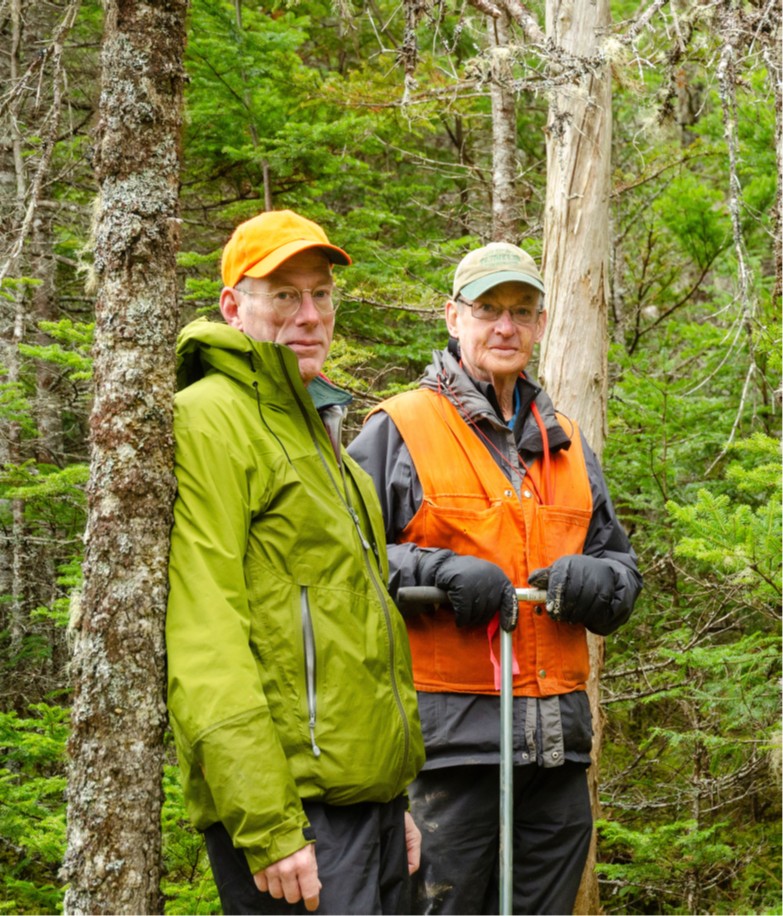
Tom and Harold
Sean Basquill, NS Department of Natural Resources
Tom wasn't big on having his photo taken, at least when I asked. I do have this nice photo from 2012 with Harold (in BFL habitat from Richmond County). I'm passing along for all to view.
Rob Cameron, former Ecologist for Nova Scotia Department of Environment
In 2003, Tom was hired under a Habitat Stewardship Program grant with Nova Scotia Environment and Natural Resources to conduct boreal felt lichen surveys.
The first years of lichen work focused on the Eastern Shore and Tom would revisit finds every year, documenting survival, health and any habitat changes. These data enabled detailed population modeling (Cameron and Toms 2018). After just 5 years of Tom’s work, we found that boreal felt lichen thalli were dying faster than they could found. This led to establishing the first lichen special management practices for forestry in Canada. These beginning years of lichen work on the Eastern Shore were done largely in the fall, often rainy, wet or sometimes snowy weather. Tom would spend days on his own traipsing into the remotest parts of this rugged granite strewn wilderness.
In the 2000’s Tom and I made several forays to the island of Newfoundland to study boreal felt lichen there. A week was spent with Claudia Hanel, species at risk botanist, who guided us around to many sites they had and to meet the lichenologists on the island.
In 2005, NS Environment received some funds to study the effects of pollution on lichens in Halifax City. Tom and I spent several weeks wandering in and around the city with our measuring grid, documenting the species and their abundance. This study was published in 2007 (Cameron et al. 2007). One of Tom’s many vole ear lichen findings in 2007 was on a rotting yellow birch next to a logging road. It was decided the lichen was in imminent danger and after much investigation, measuring of habitat and consideration, several of the vole ears thalli were transplanted to habitat nearby. The lichens thrived for at least 5 years after which they were no longer monitored.
Tom spent long hours measuring habitat parameters of boreal felt lichen and later vole ears lichen. His data was invaluable, allowing the creation a more refined boreal felt lichen model as well as models for vole ears, blue felt lichen and other lichens (Cameron and Neily 2008, Cameron et al. 2011, Pearson et al. 2018, Power at al. 2018, Cameron 2021).
Combining Tom’s habitat work and population monitoring enabled us to draw the link of the effects of forestry on boreal felt lichen mortality (Cameron et al. 2013).
Harold Clapp, volunteer
I was fortunate enough to have spent a lot of time with Tom.
Years ago, when we were both younger, and he was the field biologist at MTRI and I was a volunteer, I accompanied him on field trips looking for BFL Boreal Felt Lichen or Erioderma pedicillatum, the most sought after lichen of our quests. We traveled around the province, from Yarmouth to Cape Breton, and very patiently he would show me the different species of lichens and bryophytes in the coastal fir and maple swamps where we searched.
Some my fondest memories of Tom were the times we spent together while he was fighting his cancer. Those last few years he was no longer able to get through the woods in his usual fashion and he had to make his way using a walker or his two hiking poles. But he still enjoyed getting out looking for whatever interesting species might be around and we would drive along the back roads and Tom would watch out the window until something would catch his eye. Maybe something in the ditch or a tree on the side of the road or a corn field and off he would go. And he would find some great stuff! Sphagnum platyphyllum, which is a great find for anyone, in a ditch no less. One time he says “Stop” and he’s looking at a large old poplar tree. “Check that out, Harold!” Well, I had to come back with a ladder later on but there was Pannaria lurida. Or, “That looks like a black ash” and sure enough that’s what it was. He never let his illness diminish that, getting out in nature and looking for the interesting things he found there.
Burke Korol, Sackville, New Brunswick
I never met Tom, but I was always impressed with the exceptional quality of his iNaturalist photos of bryophytes and his willingness to identify my bryophyte posts on that platform. Just before I moved to the Maritimes I was having trouble finding some dye to stain Sphagnum slides, so I asked Tom where he got his. Within a few days he had mailed me a lifetime supply of Gentian Violet. Tom refused to accept any payment for the dye or postage.
Colin Chapman-Lam Ottawa, Ontario
I feel lucky to have been on multiple field excursions with him, and always enjoyed the debriefs in the evenings when we would talk about the lichens and bryos we found.
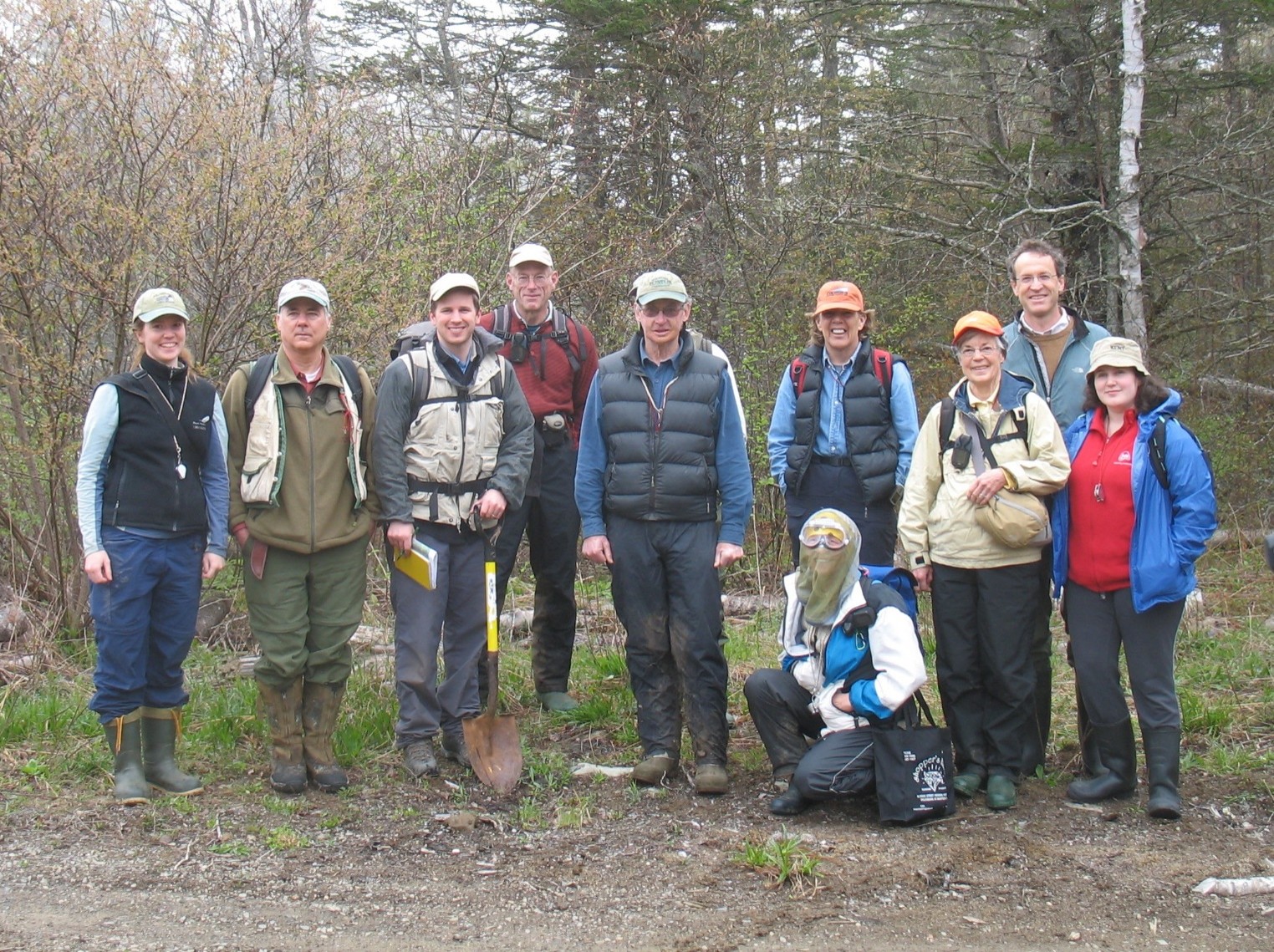
Left to right, A. Lavers, S. Selva, S. Basquill, Tom Neily, R. Cameron (hidden), H. and D. Clapp, F. Anderson (kneeling}, A. Mills, S. Clayden, K.Driscoll
Kendra Driscoll New Brunswick Museum, Saint John, New Brunswick
When I was still young and relatively new to lichenology, I had an enviable opportunity to spend a couple of days in May 2009 exploring the Hectanooga NS cedar swamp with Tom Neily, Stephen Clayden, Steve Selva, Rob Cameron, Frances Anderson, Anne Mills, Harold and Diane Clapp, Sean Basquill, and Amanda Lavers. Most of the details of that trip have faded in my memory over the years.
I remember the ferry ride from Saint John to Digby. I remember that the forest was a little different from the Thuja woods I’d visited in NB, featuring scattered Fraxinus americana (white ash) instead of Fraxinus nigra (black ash). I remember being led, by Tom, through a grassy meadow full of dog ticks to some hardwoods where I saw Sticta fuliginosa for the first time in my life. I remember the sense of camaraderie and shared enthusiasm. I also remember that Tom took the time to talk to me about the impending end of my employment at the New Brunswick Museum, and to offer encouragement and thoughtful advice for the future. Though things worked out differently from my expectations—I neither left the museum nor pursued a career as an independent consultant as I had tentatively planned—I will never forget his kindness in offering the benefit of his extensive experience. I felt seen, and accepted as a rookie member of a larger community of capable, knowledgeable, wonderful people. Though I never got to know Tom well, I feel quite certain he offered such guidance and welcome to more than one young biologist facing an uncertain future. He will be remembered, and missed, by the whole community of cryptogam enthusiasts in the Maritimes.
Katie Porter, Moncton, New Brunswick
I’ve been thinking about the impact he had on our community. Beyond his direct contributions to science, his legacy includes the support he provided to others and which ultimately strengthens the science we do, and also awareness about rare lichens (and bryos!) throughout our region. He was incredibly generous with his time and expertise. He supported so many people in the maritime lichen practitioners group through either direct mentorship, including us on surveys, or the field trip workshops he organized. I wish I’d had the chance to spend more time with him, but every interaction I had with him was thoughtful and encouraging. I feel like some part of the article might mention his role in his capacity within the community as a teacher; it’s probably already on the radar, but I wanted to add my two cents.
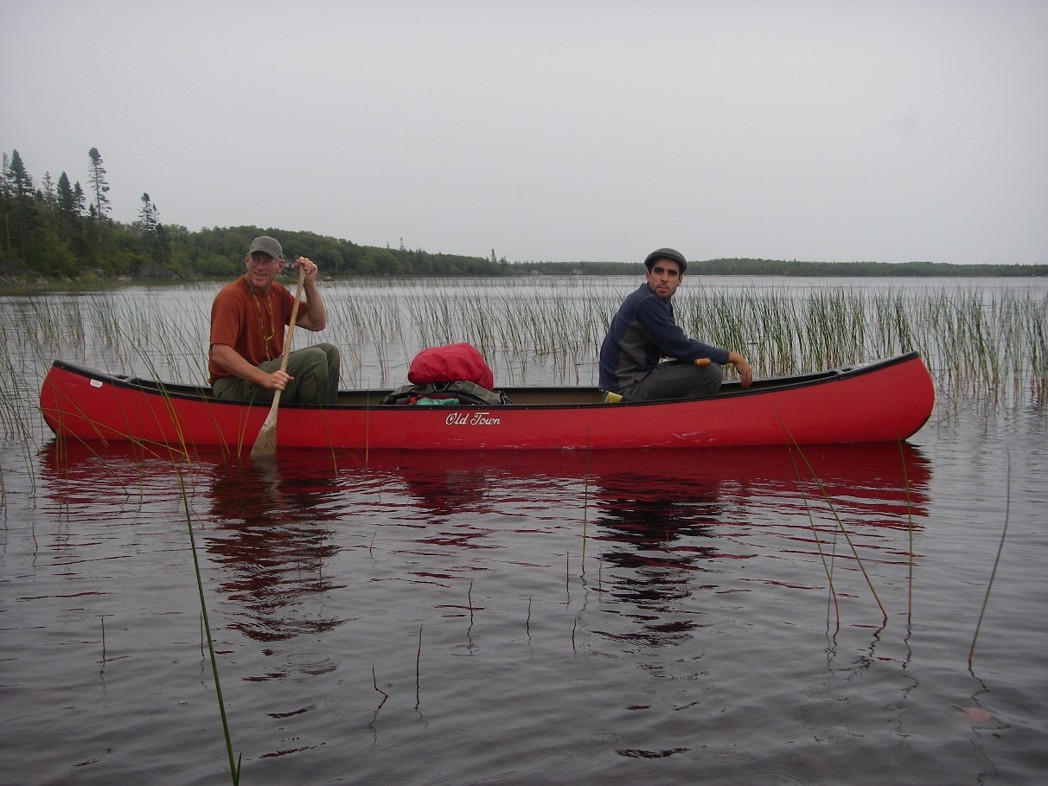
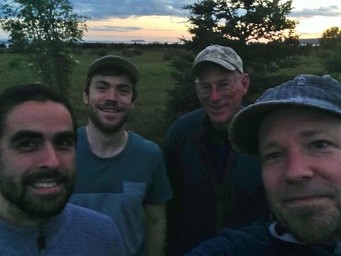
L to R: Alain Belliveau, Cole Vail, Tom Neily, James Churchill
Allain Belliveau
Here's another photo with Tom in it. The four of us spent the day on Isle Haute. Isle Haute is in the background.
Tom found some good stuff there, including the first occurrence of Yellow Ladies Slippers on the island, and possibly the first (maybe second...) found on basalt bedrock ion Nova Scotia, which represents a fairly large area. He had a blast, and it wasn't long after this (2019) that his health issues started to come up, if I recall.
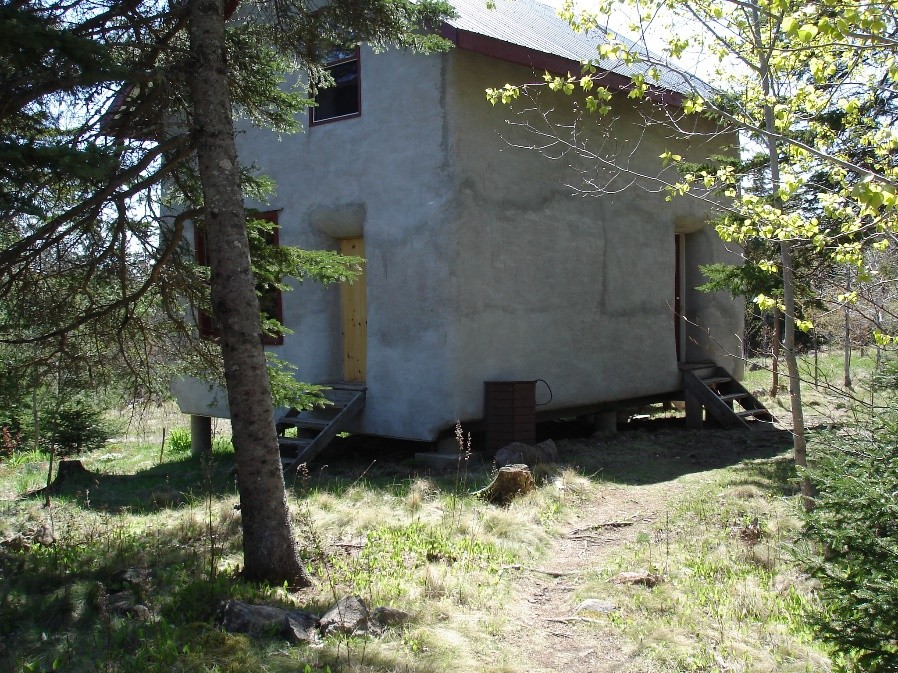
I'll tell you another story about Tom. In the mid-2010's, I visited him at his straw-baled house and we chatted for a while about anything and everything.
He showed me his canoe in the shed, that Harold had helped him purchase. He said he never used it, and would consider selling it to me. A while later, he said I could buy it for $300. This was an incredibly small amount of money for it, but at the time it was all I could offer too, so we agreed to the deal and I said thanks a million times. As a continued thanks, on many occasions, I kept sending him e-transfers for a few hundred $ at a time when I had some spare cash from odd jobs. I'd send them, I'd get an email telling me that he'd accepted them, and we wouldn't even exchange any words, haha! My first e-transfer included a memo, saying that it was a thanks for the canoe, which I gave to Charlotte right away and she loves it. The next e-transfers had no memos. I don't actually know how much I ended up sending to him, but I didn't mind it at all. He had such a big heart, and I knew he was going through health stuff, and that he'd appreciate it. All of that without any spoken words.
Kelly Regan, Dillon Consulting Ltd
On a personal level, I had the privilege of working directly with Tom on several major projects, including the
baseline surveys for the Highway 107 extension to Burnside, as well as due diligence Species at Risk (SAR)surveys for the Department of National Defence and other federal departments all across Nova Scotia.
Tom was an incredibly fun person to work with. A few things that will always stand out to me:
• His Pace: Anyone who went into the field with Tom knew he walked way too fast! Trying to keep up with him was always an adventure.
• His Mentorship: Despite his quiet nature, he was incredibly easy to talk to and a fantastic listener. He took a genuine interest in the professional development of junior staff, generously taking the time to help me and others hone our plant identification skills in the field.
• His Humor: He had a wonderful sense of humor, his eyerolls and laugh.
Tom's contributions left a lasting mark on our team and our projects.
Karen March (retired), Dillon Consulting
Tom was truly a “World Class” botanist.
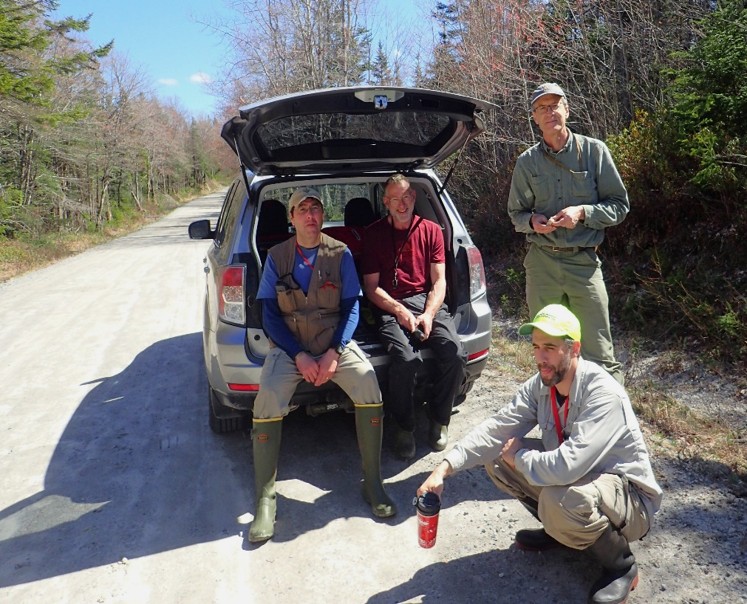
Left to Right: Rob Cameron, Tom, Stephen Clayden, Sean Haughian . Canada Hill, Shelburne County
Stephen Clayden, New Brunswick Museum (retired)
Tom radiated curiosity and kindness. Although we saw each other infrequently, I found him a kindred spirit as a naturalist and botanist. I will happily remember the too-few times we got together in the field and herbarium, his impish sense of humour, and our long-running correspondence. Our first contact was during the winter of 2004–2005, when he sent me several lichen collections from North Mountain. More followed and he began depositing selected material in the herbarium of the New Brunswick Museum. We shared wider interests in natural history. He wrote to me about searching for Hepatica in flower in April, about forests that had “escaped the axe for a long time,” the “melodious chirping” of an unidentified bird in the middle of the night, visits to waterfalls, collecting lichens in February “despite the cold temperatures … a good time of year to visit the swamps … less likely to get wet feet.”
In July 2005, we travelled together to Eagle Hill in Maine for a course I led on the identification of Cladonia and Stereocaulon. The following spring, after a meeting in Halifax on the status of Nova Scotia cyanolichens, organized by Rob Cameron, Tom took Frances Anderson, Dwayne Sabine and me to see a new locality for Erioderma mollissimum and E. pedicellatum that he’d discovered north of Musquodoboit Harbour. Around this time, he noted that his increasingly technical studies of bryophytes and lichens pointed to “the necessity of a well-equipped lab.” Apparently intending to purchase a good-quality compound microscope, he added: “That will be my focus for this season and will keep me from attending any courses.” When he did return to Eagle Hill, he concentrated on studies of bryophytes, especially peat mosses. He launched into intensive collecting of Sphagnum throughout the province, finding several previously unrecorded species and adding much to knowledge of the distributions and habitats of others (Basquill, Haughian & Neily 2024). Meanwhile, his lichen studies and expertise continued to grow, too.
Together with Frances and Harold Clapp, Tom first recognized the significance of the extensive cedar swamp-forest near Hectanooga for rare lichens. Having discovered Leptogium hibernicum there in January 2009—an occurrence that he and Frances subsequently reported as the first North American record of this species (Neily & Anderson 2010)—in May he led a larger group of lichen folks on a two-day exploration of the stand and surrounding area. Steve Selva, Kendra Driscoll and I had already been surveying lichen diversity in old wet cedar woods in New Brunswick and northern Maine. Seeing the stand at Hectanooga broadened our perspective on variation in this lichen-rich community type across the region.
The scarcity of cedar swamps in Nova Scotia versus their widespread occurrence in New Brunswick contrasts with the greater frequency of lichen-rich red maple-dominated and mixed fir-maple swamp-forests in Nova Scotia. In the spring of 2017, Tom, Frances, Rob, Sean Haughian and I made this the theme of two fun trips on which we targeted a range of stands in southwestern NS and eastern NB.
Granular data on species occurrences of the kind that Tom carefully acquired over many seasons of field work has supported efforts by Rob, Sean and others to model the distributions of several lichens of conservation concern in these and other habitats. His collections and observations will contribute to the conservation of many other species and natural areas long into the future.
Tom’s most notable field work in New Brunswick was in 2017 and 2018. Working on a project led by the Atlantic Canada Conservation Data Centre, he surveyed bryophytes and lichens along remote segments of several of the province’s northern rivers that carve deeply through calcareous bedrock (Mazerolle et al. 2019). His keen eye for small cyanolichens, honed by his and Frances’s earlier studies in Nova Scotia, detected numerous species of interest in this group, including several that proved to be first records for the province or the Maritimes. In both of those years, Tom and Frances and I met up in October in the Cobequids and hiked along parts of the lower Economy, West Moose, and French Rivers.
In November 2018 they came to the NBM herbarium for a few days and we huddled over microscopes, working on some of Tom’s recent collections from northern NB. At the time, I had begun planning with Sean and others to host a Crum Bryophyte Workshop in the Miramichi region during the following year. Tom was keen to take part. But in the spring of 2019 he was diagnosed with the serious illness that he contended with so bravely for the next several years.
And so it went, through to his last weeks. We can wonder, and remember, and take to the fields, forests, and rivers.
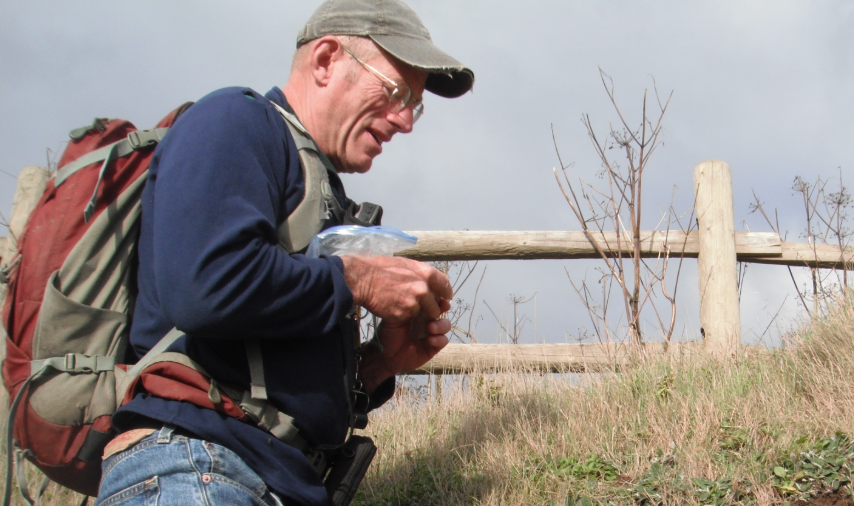
Port Hastings Peltigera hydrothyria site 2010
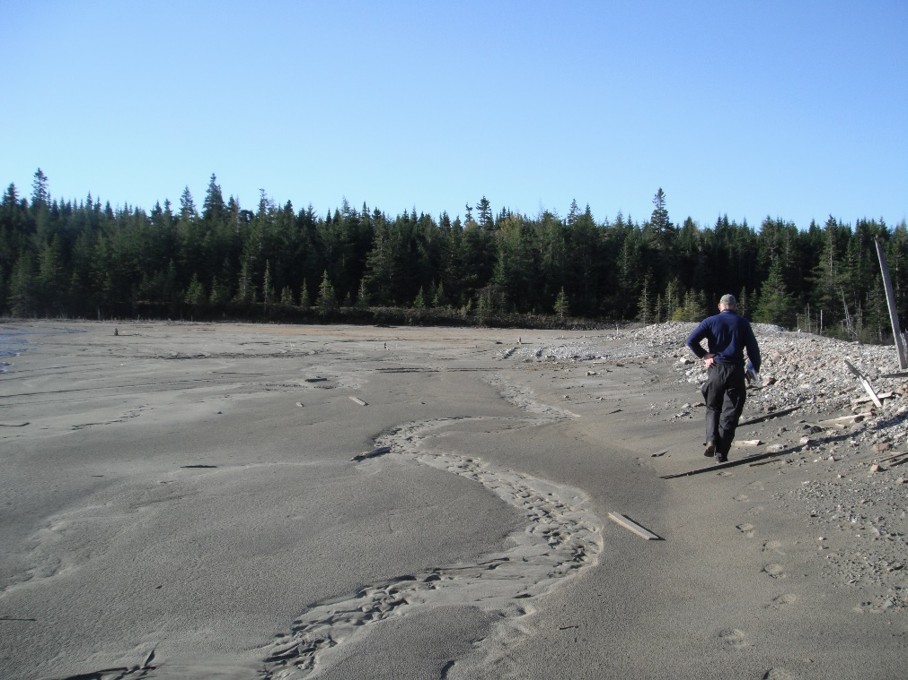
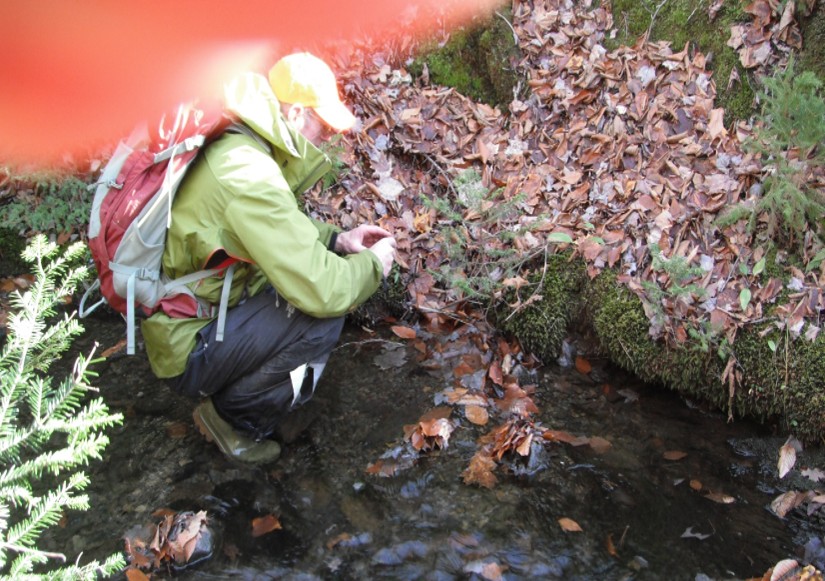
Stirling Mines tailings Pond 2012
Frances Anderson, Upper LaHave, NS
It’s no longer in my memory how Tom and I met, but our friendship started over 20 years ago. For some reason, we hit it off early on. He had done much exploring on his own, and would bring me puzzling specimens that we would consult about. Cyanolichens had captured both our fancies, and we spent the next 20 years ranging around the province to see what we could find, sometimes writing things up in a paper. At least once and usually twice a year, we’d rent a cabin or stay in a motel somewhere, usually Tom’s choice, and spend several days hunting cyanos. If he could get a grant to finance our explorations, as he did with our investigation of karst outcrops (Anderson& Neily 2010), he would.
We’d spend time poring over maps and documents (early internet days to start), usually separately - Tom in Middleton and me in Upper LaHave, consulting often by phone, and Tom would decide where we’d go. The best times were of course late winter/early Spring and late Fall, outside field season for consultants, in addition to being the seasons with the fewest bugs and fewest leaves on shrubs and trees. Tom was a good cook. We both liked spicy foods and sweet things, though Tom’s sweet tooth surpassed mine by a long shot. We’d each bring our contribution to the nights’ suppers if we were staying where there were no restaurants.
Tom in the woods was amazing. Before we all had phones and iPads with Google Earth and other mapping programs on them, with his GPS, maps and compass and his amazing speed in the woods, Tom would navigate us to whatever destination he had chosen and back out without hesitation. Since he did most of the advance planning for our selected sites, I followed along, hoping to keep up with him. Once when several of us were out deep in some woods in Guysborough County, I was convinced we were going in the wrong direction to get back to the cars. I challenged Tom’s choice of path out and we argued. He got mad, which rarely happened, and went off on his own, following his chosen direction. His gentle, generous, accepting nature had just been pushed too far. He was right of course, and I don’t think he ever quite forgave me, but it was the only time in our long friendship that we really crossed swords.
He was like a mountain goat at scaling uneven and steep territory. He’d zoom up whatever it was, and bring down interesting things for me to look at. Our ramblings were often three or more days in the field, but we made day trips as well. If he thought a site would have interesting lichen species at risk or the potential for new and different cyanolichens to both of us, he’d suggest that we go there.
As time passed, our foray focus shifted from lichens to bryophytes AND lichens and as his condition progressed we went on fewer long explorations. We stayed closer to his home, with less emphasis on remote areas and long hikes. Though he was always interested to know what new and exciting lichen species were turning up in the province, once his exploration range became more localized, he bore his shrinking world with grace and dignity, and didn’t complain.
Tom settled into his new house, all on one floor and easy to manage, where he developed an interest in cacti and succulents. His collection, as with all his others, became extensive and dazzling. Each time I visited, there were more. If I took a particular fancy to one, he’d give it to me to take home, even though I warned him my thumb was black. He nurtured and cared for his plants with all their various requirements for light, water and warmth, yet gave them away with his typical generosity.
I miss him.
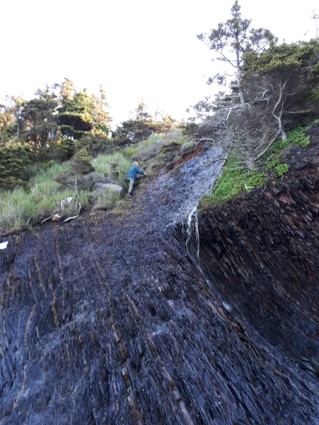
Mavillette Beach 2018
Barr Brook 2020
Cobequids 2012
Tom Neily on Brier Island circa 2016
Nick Hill, Fernhill Institute
Reconstructing the history of Big Meadow Bog with Tom Neily.
Big Meadow Bog had been ditched and drained for more than 50 years when Environment Canada began a restoration program to halt its degradation to recover the habitat of the Endangered Eastern Mountain Avens. Search the depths of the bog for evidence of the Avens pollen or seed would have been futile as a seed bank study proved but Tom Neily in the lab in the straw-bail house was able to apply his rigour to search out the stem and branch millimetre scale Sphagnum leaves still preserved in the peat to reconstruct the succession of the wetland whose last stage only was a bog (Figure 1 from Northeastern Naturalist Fig 4). The largest spoon-shaped leaves of Sphagnum magellanicum, jewels under the cover-glass after two thousand years, confirmed, with the upright tree trunks, that the peatland had begun as a Black Spruce swamp. Other species (Sphagnum affine) and groups (Section Acutifolia) were resolved by sectioning stem or branch leaves to confirm the presence of septation of hyaline cells or comb lamellae of cortical cells.
Tom’s expertise, scientific method and patience led to the understanding that Big Meadow Bog went through marsh stages before it became a treed swamp, a fen with S. affine, and finally a raised bog with the loss of S. affine and dominance of Section Acutifolia.